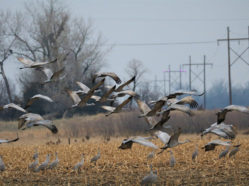
UV Lights on Power Lines May Help Save Sandhill Cranes
Crane species are declining around the world, and lethal collisions with power lines are an ongoing threat to many crane populations. Current techniques for marking power lines and making them …
Crane species are declining around the world, and lethal collisions with power lines are an ongoing threat to many crane populations. Current techniques for marking power lines and making them …

One of the curious traits shared by birders and professional ornithologists is an abiding interest in bird names, both common and scientific. With respect to common (English) names, I have …
The American Ornithological Society’s Katma Award is intended to encourage the formulation of new ideas that could challenge long-held accepted views and possibly change the course of thinking about the biology of birds. This award, proposed and sponsored by Dr. Robert W. Storer, is to be given to the author(s) of an outstanding paper related to ornithology and published in any journal that offers unconventional ideas or innovative approaches, backed by a well-reasoned argument.
AOS is proud to recognize the students and postdoctoral researchers who are receiving research funding through our 2019 Student and Postdoctoral Research Awards! These annual awards, each up to $2500, honor …
Imagine having a conversation with someone next to a very busy intersection at rush hour. You can’t hear one another at a normal volume, so what do you do? You could talk louder, maybe wait for the noise to die down, or simply pick up your belongings and move to a quieter setting to converse.
Every two years, the American Ornithological Society bestows the Harry R. Painton Award for a paper published during the preceding two years in The Condor: Ornithological Applications that has made an exceptional contribution to ornithology.
Scientists have long thought that for two related populations of birds to evolve into separate species, they needed to be completely separated. This usually means the kind of total separation produced by isolation on islands or by features such ice sheets, mountain ranges, or rivers. However, the complex distributions and migratory nature of many birds mean that long-term total separation of bird populations, long the assumption in speciation research, is actually not necessary for speciation to occur.
After a seminar last week, my colleague Jannice Friedman, a botanist, asked me if ‘oology’ was really a word, as it had appeared on one of the speaker’s slides. So, …
Many species of migrant songbirds have a reproductive strategy called protandry, where males arrive at stopovers and breeding sites earlier than females. Ornithologists believe that males do this because it increases their mating opportunities and reduces competition among males for high-quality nest sites. Although it’s a common phenomenon, the question of how males arrive earlier is still unanswered for most species.
In years when winter conditions are especially harsh, birds that depend on conifer seeds for food are sometimes forced to leave their homes in northern forests and wander far from …