A blog post based on the Special Feature article in Ornithology: “Considerations and Suggestions for Field Research on Female Birds”
By Cristina M. Barros
Related paper: Considerations and suggestions for field research on female birds by Cristina M. Barros, Joanna X. Wu, Renata Beco, Rebecca A. Glisson, Michelle J. Moyer, Karan J. Odom, Christopher A. Tarango, Chris J. Walker, Natalie A. Wright, Lauryn Benedict. Ornithology.
At the AOS 2024 annual meeting, fellow ornithologists and I were invited to present academic talks during a female bird symposium (see page 42–46 in linked document) organized by Joanna Wu aimed at highlighting recent research on female birds. The symposium was titled “Focus on females: Novel insights from studies on female song, behavior, and physiology.” Following the talks, we were excited to connect with one another in an open discussion about female bird research and future directions.
During that open discussion, I realized that most of us presenting research on female birds reported having to take a different approach to studying females versus males of species we were investigating. Many speakers also commented that the outcomes of their studies were surprising, given expectations based on hypotheses developed about males of their species.
In the days following the symposium, I began brainstorming this idea that investigating female birds often requires methods and techniques that differ from how males of their species are studied. For example, female birds may occupy different habitats, vocalize at different times of day, respond differently to playback experiments, or require different capture methods and observation strategies. Nonetheless, practical guidance on adapting field methods that account for said differences is rarely compiled in one place.I also noticed that this information is not readily available for those (like myself) who are new to the field, and that many female bird researchers could benefit from a repository of collective knowledge on studying female birds. In addition, although much field knowledge comes directly from learned experience and trial-and-error, there are research methodologies and secrets of the trade in female bird research that are passed down primarily through word of mouth or in small academic circles.
When the editors of Ornithology invited presenters in the female birds symposium to submit papers for a special feature, I decided to invite fellow researchers to collaborate on a methods paper providing useful considerations and suggestions for investigating female birds. Our paper’s ten authors have different areas of expertise in subdisciplines of ornithology, with extensive knowledge and experience in field techniques such as capture methods and measurements, acoustic sampling, tracking studies, and behavioral observations. These authors also represent a range of career levels, from beginning graduate students to academics who have been in the field for decades.
Even with ten perspectives, however, we are acutely aware that we don’t know everything about studying females, and we want to learn from all of our ornithological colleagues with expertise on female birds. Thus, we have written this blog post in an effort to archive comments and suggestions as an ongoing conversation for anyone who has useful advice or information to contribute, and for those seeking this practicable information.
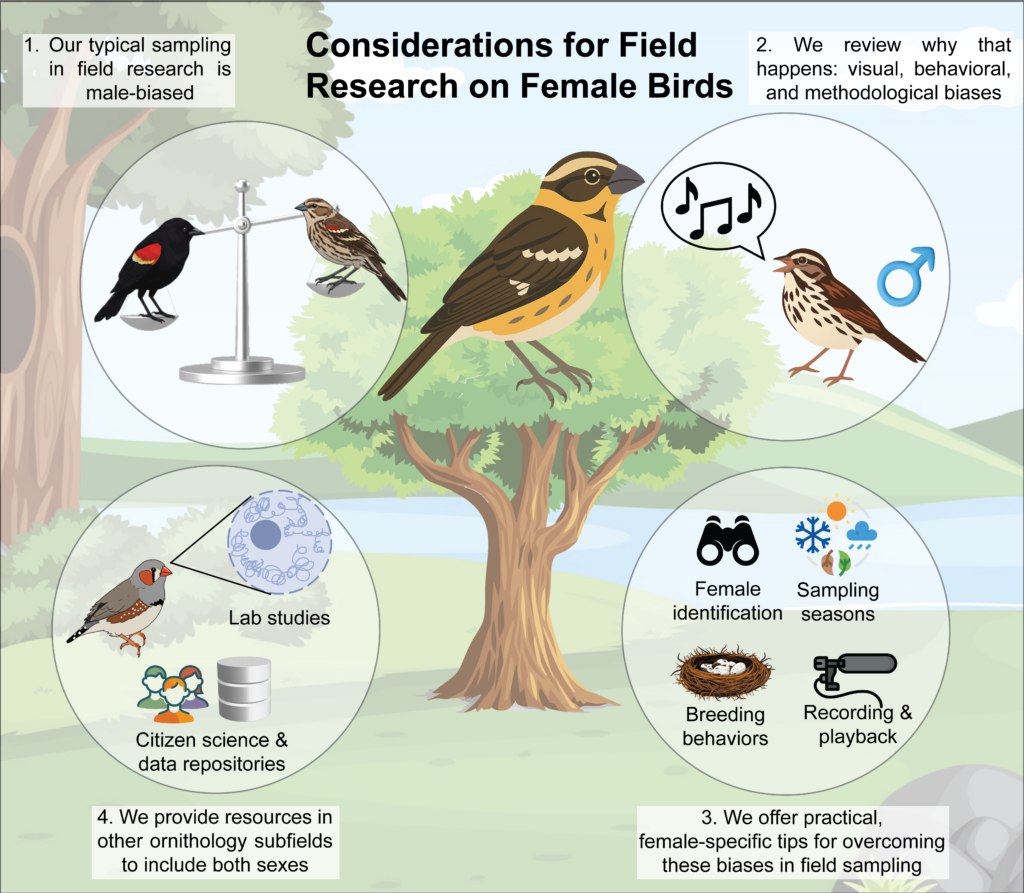
The recommendations provided in our article are grounded in examples drawn from multiple subfields of ornithology. Our article discusses subjects such as how females of many species occupy different habitats than males, and offers suggestions for conducting field research in a way that can account for these differences. In another example, in this paper we also describe documented sex differences found in behavioral traits such as boldness and neophobia, especially towards human observers, for various known avian species. These differences can have downstream effects that impact the outcome of behavioral studies, population surveys, playback experiments, and other field-related investigations. In this paper, we provide researchers with suggestions on how to detect and account for these differences in the field. Rather than offer a single protocol or solution, our goal is to supply researchers with a varied toolbox of methods that can be used to design studies that more accurately represent both sexes.
If you have suggestions about how best to study female birds in the field, please comment on this blog post and keep the momentum going!
Reflective thoughts from the authors
“Most of what I know about how to do field work I learned through word of mouth and demonstration from my mentors and peers. There is a lot of knowledge that gets handed down within labs that would benefit everyone, so I wanted to be part of a group that is making that knowledge more widely known. I hope our article and the discussion thread on this blog will help us all do better research on female birds.“
–Lauryn Benedict
“Studying females can be challenging and we did our best to summarize recommendations on how to decrease the female bird bias on research and community science. We did this based on our knowledge and on the literature, but there are certainly more recommendations that we don’t know. This blog will be a powerful tool to keep updated on all the suggestions different people might have on studying females!“
–Renata Beco
“Female birds make up 50 percent of the bird population and remain understudied. With our paper, we hope to point scientists towards the right direction when studying females, ensuring females are thoroughly covered in their respective research fields. Hopefully future studies can be deliberately built with females in mind.“
–Chris Walker
“As I started my career in this field, I was surprised to learn how many elements of traditional or ‘classic’ field methods might be inaccurate for studying females, and, as others have mentioned, up-to-date methods can be hard to hear about. Many people I encounter still don’t realize that most female birds sing, for example! It’s easy to overlook what you aren’t looking for, and I’m sure there is even more to learn, but we hope that these suggestions will make field studies more accurate and give us better insight into the questions we’re asking.”
–Michelle Moyer
“Many people took up birding as a hobby during the coronavirus pandemic shutdown, which brought a love of birds to a wider audience. I believe articles like this one are crucial for encouraging this passion by making ornithology a more accessible and diverse field where everyone is welcome.“
–Rebecca Glisson