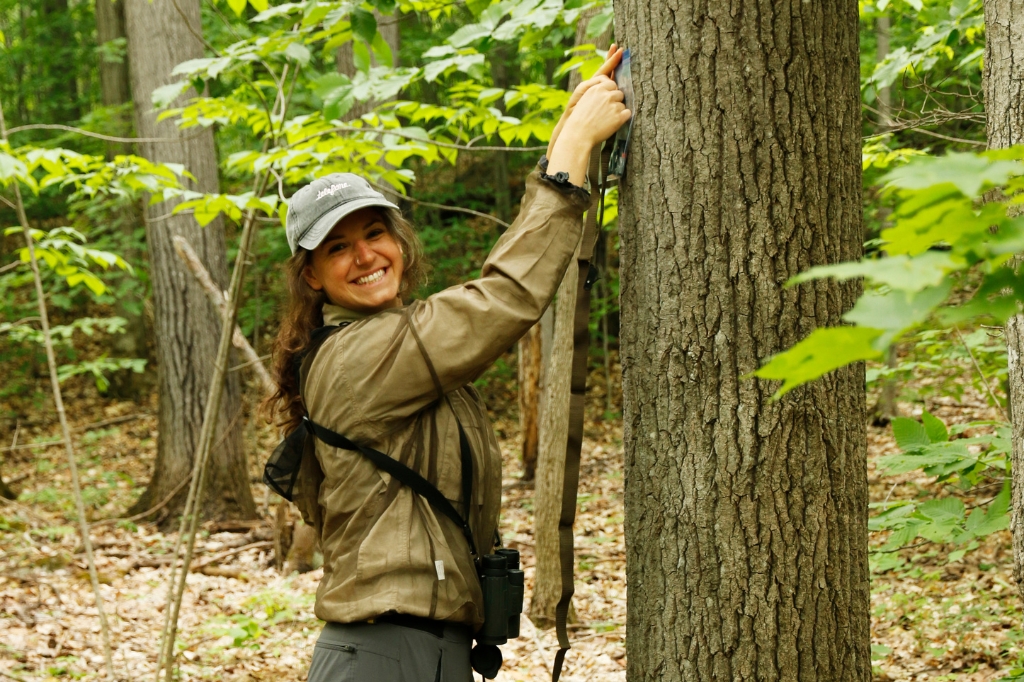
By Millicent Gaston
Related paper: Temporarily closing roads to motorized vehicles may benefit some sensitive bird species in a peri-urban park by Millicent V. Gaston, Greg W. Mitchell, Paul A. Smith, Joseph R. Bennett, and Rachel T. Buxton. Ornithological Applications.
It is widely known that roads and motorized vehicle traffic threaten wildlife populations on a global scale. Millions of birds die on roads each year. Traffic also increases stress, alters behavior, and interferes with communication, reproduction, foraging, and predator avoidance. Despite these known negative effects, few traffic management actions exist that explicitly target birds, and of the strategies that do exist, even fewer have been evaluated for efficacy.
Tools to prevent collisions between wildlife and vehicles, such as wildlife-crossing structures and fencing, tend to focus on large mammals due to human safety and economic concerns, along with reptiles and amphibians, due to their disproportionate vulnerability to road mortality. Further, many traffic mitigation measures do not consider the effects of traffic noise, which can particularly impact birds. While noise-absorbing asphalt, electric vehicles, and tire and muffler modifications can mitigate some noise, this could require costly adjustments and challenging collective change as a society. It is estimated that an additional 25 million km of paved roads will be built by 2050 (see this report), while climate change is expected to intensify road and traffic effects and reduce species resiliency. Thus, finding solutions to mitigate the detrimental effects of roads and traffic is pertinent.
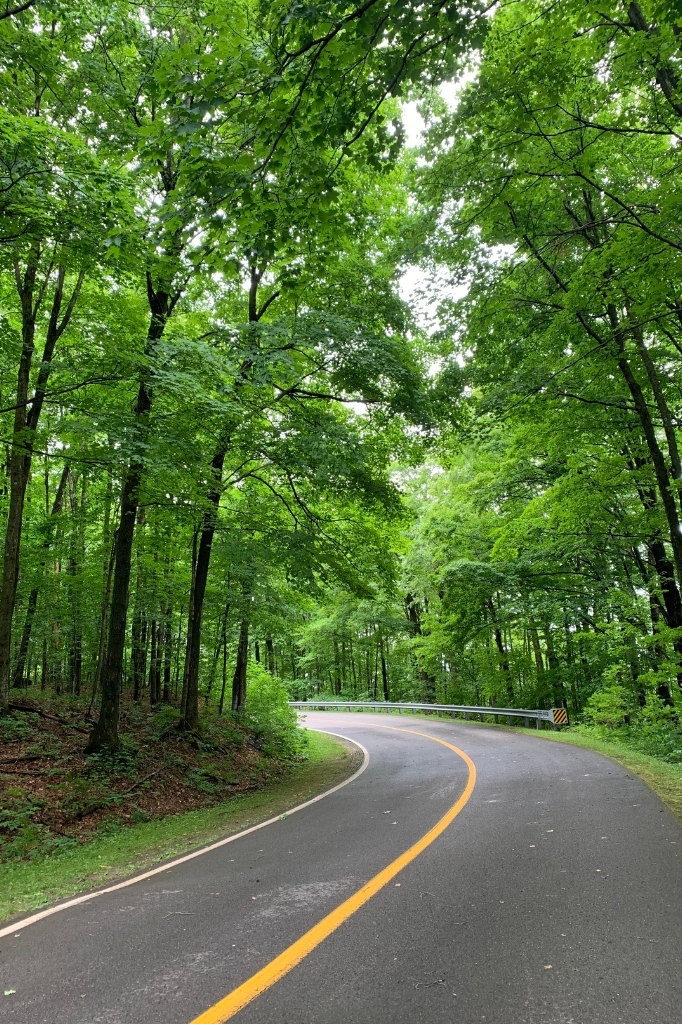
A road temporarily closed to motorized vehicle traffic in Gatineau Park, Québec, Canada. Photo by Millicent Gaston 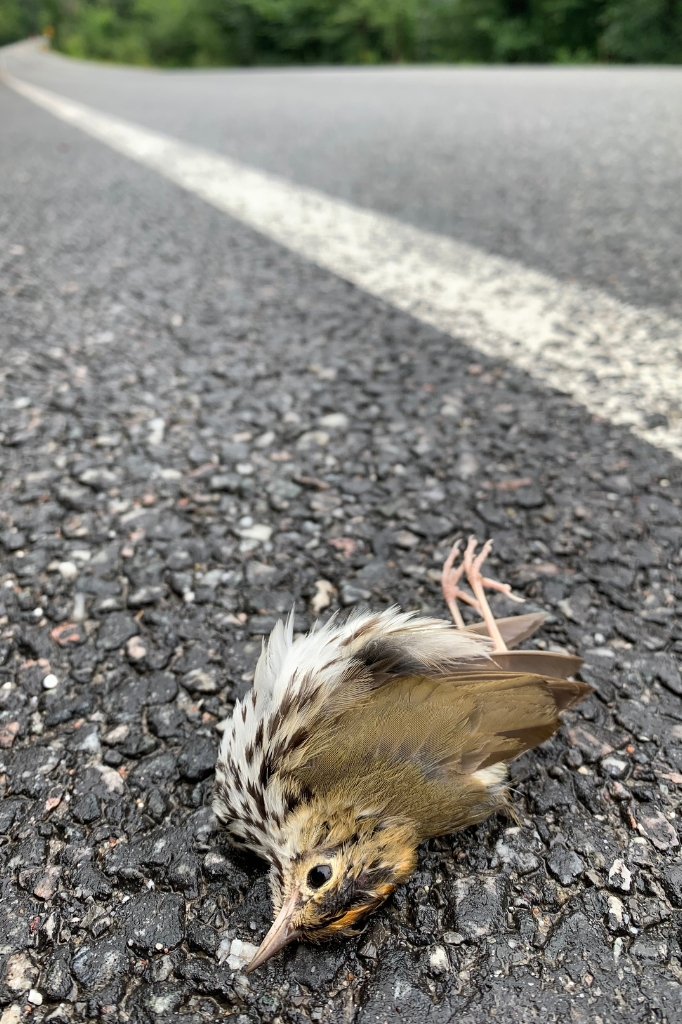
Seiurus aurocapilla (Ovenbird) road mortality in Gatineau Park, Québec, Canada. Photo by Millicent Gaston 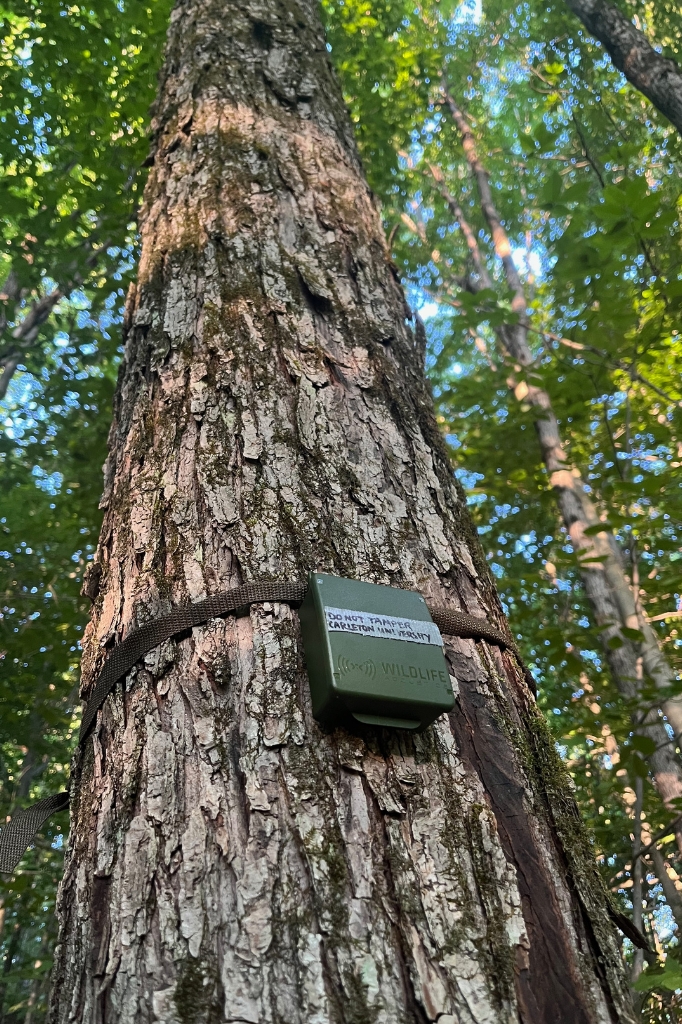
A Song Meter Micro (Wildlife Acoustics, Inc) acoustic recorded deployed in Gatineau Park, Québec, Canada. Photo by Millicent Gaston 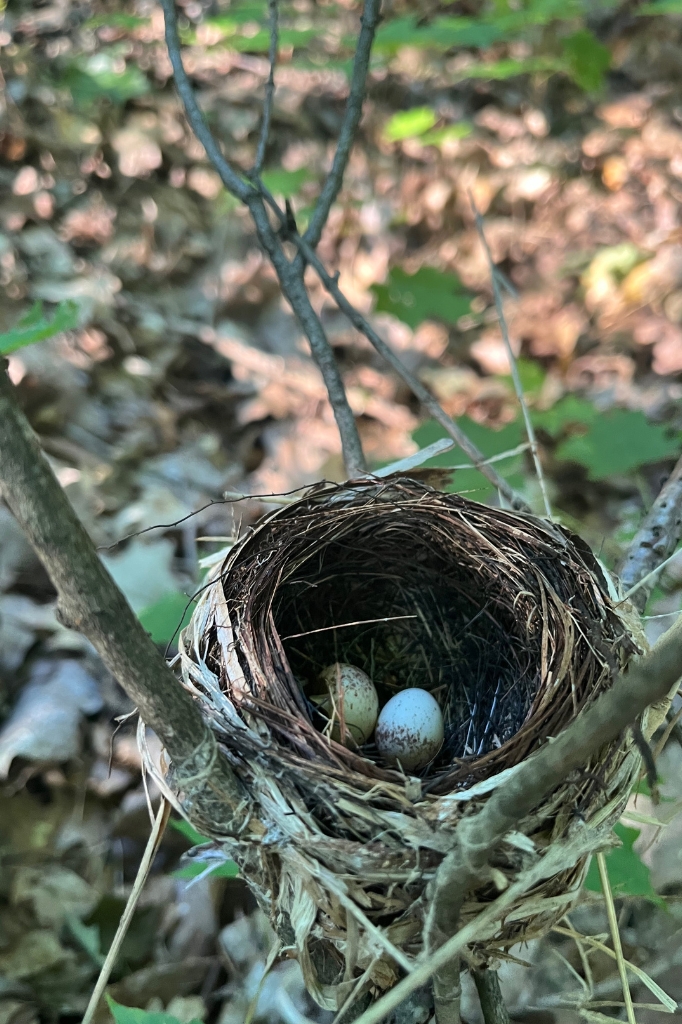
A Setophaga caerulescens (Black-throated Blue Warbler) nest, one of our study species we determined to be sensitive to roads and traffic, found at a study site in Gatineau Park, Québec, Canada. Photo by Millicent Gaston
Temporarily closing roads to motorized vehicle traffic is an alternative intervention with the potential to reduce traffic noise and mortality of focal species, while being relatively low-cost and adaptable, mitigating traffic during high-risk times like dawn and dusk, during the breeding season, or along migration routes. While road closures are obviously not feasible everywhere (like major highways and commuter routes), they could reduce the impacts of traffic in parks, where high-traffic roads and human recreation intersect high-quality habitat for many species. However, road closures that benefit birds may limit human access to natural areas, present ableist barriers, and affect tourism and local businesses, making assessing outcomes particularly important.
The overall objective of this study was to measure outcomes of temporary road closures on forest bird diversity in Gatineau Park, Québec, Canada. We deployed 30 acoustic recorders at either 100 m or 500 m from roads that were temporarily closed to personal vehicles four days a week (but still accessible to public transportation), a road permanently closed to all vehicular traffic, and roads with no traffic restrictions. After listening to hours of acoustic data, we analyzed differences in species richness, diversity, community composition, species detection rates, and occurrence of species at risk relative to varying traffic restrictions.
Counter to our predictions, we found no strong effects of roads or traffic on community-level diversity. However, we demonstrate more detections (relative abundance) further from roads and in areas with permanently and temporarily closed roads, relative to areas with no traffic restrictions, for sensitive species such as Setophaga caerulescens (Black-throated Blue Warbler), Piranga olivacea (Scarlet Tanager), and Certhia americana (Brown Creeper), and species listed as at-risk in Canada, including Contopus virens (Eastern Wood-pewee) and Hylocichla mustelina (Wood Thrush). Hylocichla mustelina in particular are declining rapidly due to habitat loss and fragmentation, including a 59 percent decline across their breeding range and an 83 percent decline in Ontario alone (see this paper). Therefore, timely conservation interventions are needed for this species, and temporary road closures may be able to alleviate some of these stressors without having to permanently close roads across this species’ range.
Habitat degradation and direct mortality from roads and traffic have population-level implications for birds. Temporary road closures could provide an adaptable traffic mitigation strategy for species-specific conservation, with some parks in Canada currently implementing similar measures for other wildlife (such as mammals in Banff National Park). We recommend temporarily closing roads in high-risk areas, including in “species at risk habitat”, during vulnerable life stages, such as the breeding season and at critical times. The dawn chorus is a prime example of a phenomenon that needs more protection from noise pollution. In addition, increasing public transportation in parks could reduce personal vehicle-use while prioritizing accessibility. Finally, we recommend increasing post-monitoring of conservation interventions to ensure meaningful outcomes are being met. As bird populations continue to decline, solution-based research is necessary to learn how to share the landscape better, considering the interests of both people and wildlife, for more effective biodiversity conservation.